Introduction
Audio-based digital products can absolutely generate passive income, but only if you treat each audio product like an asset you maintain, not a lottery ticket you upload once and forget. The simplest path is usually a two-part stack: one “evergreen” catalog (audiobooks, royalty-free music, sound effects, sample packs) plus one “attention engine” (a podcast, YouTube, or an email list) that keeps sending buyers to the catalog while you sleep, travel, or get distracted by normal human life.
Market shift toward listening
Audio is having its “quiet takeover” moment. People listen while driving, walking, washing dishes, running, studying, commuting, and yes, doomscrolling with headphones. The numbers keep drifting upward, with global podcast listeners sitting in the hundreds of millions according to these rolling podcast audience growth figures. Money is following attention, too. The global ecosystem is now big enough to be taken seriously as a business, not a hobby, and this snapshot of the global podcast economy hitting billions is part of why advertisers, platforms, and creators keep showing up.
The better angle, though, is not “ads will save me.” Ads are a rate game. Downloads, CPM rates, fill rates, seasonality. Your stomach will hurt.
Creators are shifting toward community and products, and the data is blunt about it: listeners are increasingly willing to pay for premium access, with measurable movement toward subscriptions and paid communities in this listener support trend tracking. That’s not a vibe shift. That’s a business model shift.
What “passive” really means
Passive means you do the hard work upfront, then you switch to maintenance mode. You still answer emails. You still update metadata. You still re-render a file when a platform changes specs or when you realize your mastering chain was a little crunchy at 3 kHz. Passive is not absent.
It’s also not “buy gear until you feel like a real producer.” The recurring Reddit-flavored truth is that tools only matter when they remove friction: clear onboarding, stable core features, support that treats you like a paying adult, pricing that does not hide weird add-ons, and workflows that give you a win in hours, not days. Sexy promises are cheap. Boring reliability is gold.
Meta description and internal links
Meta description: Create and sell audio-based digital products for passive income with pro workflows, gear picks, platform strategies, pricing guidance, and realistic income ranges across audiobooks, podcast monetization, royalty-free music, sound effects, sample packs, courses, meditation, sleep audio, and ASMR.
On internal links, I’m a fan of wiring these guides into a simple cluster: one post on recording chain basics, one on mastering and loudness, one on metadata and discoverability, one on platform-by-platform pricing psychology. If you already have those articles, link them where the reader’s brain naturally asks, “Wait, how do I do that part?”
Pick the best format for your niche
If you want your audio product to sell, you pick the format the audience already buys when they’re stressed, busy, or curious. Not the format you personally find adorable.
A quick way to sort yourself is to choose one “narrative” product and one “utility” product. Narrative builds brand. Utility sells on Tuesday.
-
Narrative-heavy: podcast series, audiobooks, sleep stories, guided meditation
-
Utility-heavy: sound effects, royalty-free music, sample packs, VO templates, audio courses
-
Hybrid: educator-friendly lessons, language drills, vocal packs, interview kits
Validate demand before you record
Validation is mostly listening. Watch what people pay for, not what they like. Marketplace search bars are underrated: type “whoosh,” “cinematic,” “meditation sleep,” “Spanish listening practice,” “ADHD focus,” “lullaby ambience,” and see what autosuggest hands you.
If you’re in education, especially K-12 education, don’t ignore institutional buying habits: teachers and professional educators tend to share resources inside tight communities, and one solid audio lesson pack can travel through an entire school like gossip. The audience behavior matters more than your artistic identity.
Match skills to product types
Voice actors who hate marketing tend to do best with audiobooks, narration templates, and VO packs because there’s a clean delivery. Musicians who can’t stop tweaking do well with sample packs and loops because iteration is the product. Educators win with audio-first instruction because they already understand sequencing, pacing, and assessment.
The mistake is trying to become a new person to fit a product category. Don’t.
Pricing and bundling rules
Pricing is weird in audio because buyers think in “time” more than “files.” A 10-hour audiobook feels “worth more” than a 10-second impact hit, even if the impact hit took you two days to design.
Bundling fixes a lot of this. The consumer appetite for bundles is being tracked in paywall and packaging coverage like this listener demand for paid bundles, and you see the same psychology on music and SFX marketplaces: packs feel safer than singles.
Build a reliable audio production setup
Most people don’t have an “audio quality problem.” They have a consistency problem. Different rooms, different mic distances, different gain staging, different noise floors. Buyers can hear chaos.
Budget to pro gear picks
Use what you can afford, then make it repeatable.
-
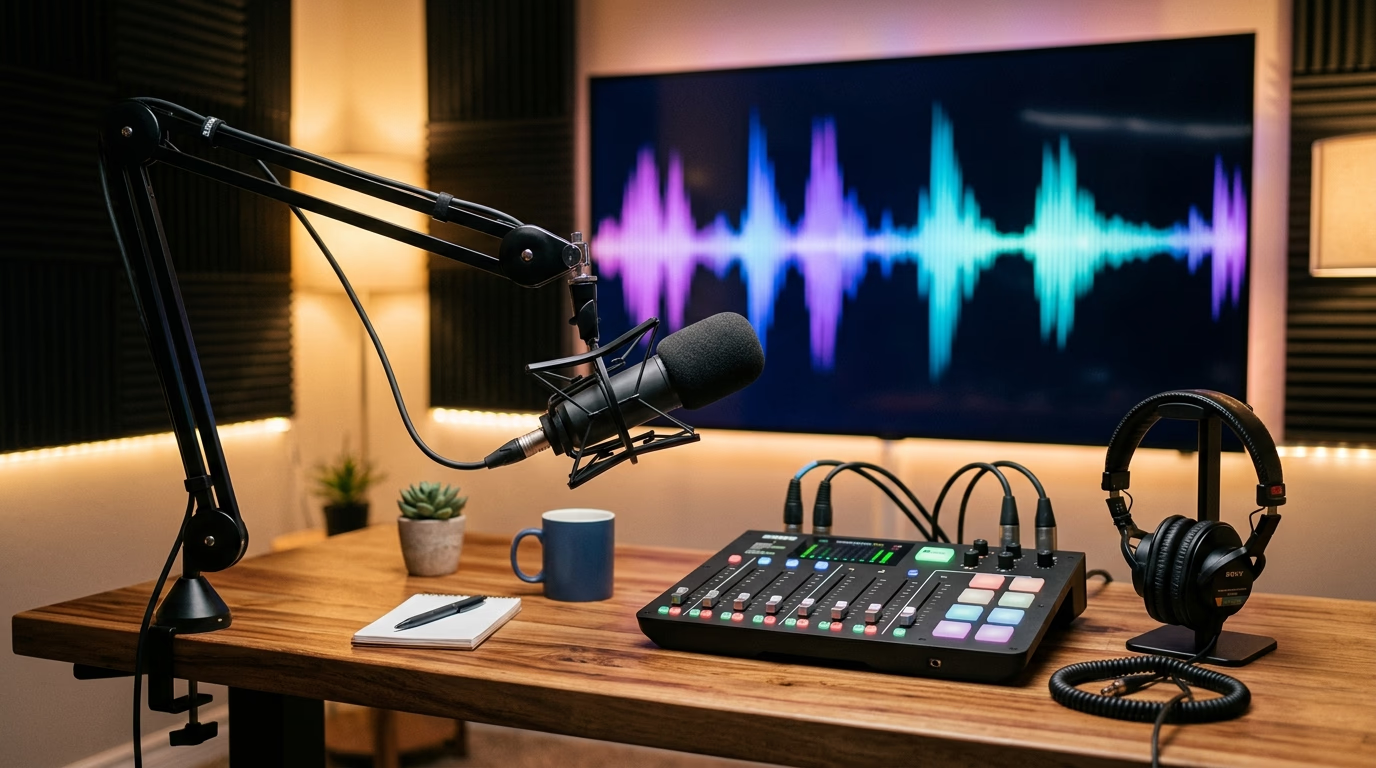
Budget but serious: Audio-Technica AT2020 (XLR) or a Shure MV7 (USB/XLR), a simple interface like a Focusrite Scarlett Solo, closed-back headphones like Sony MDR-7506, and a basic reflection filter if your room is spicy.
-
Mid-tier sweet spot: Shure SM7B (needs clean gain), Rode NT1, Audient iD14, and any decent mic stand that doesn’t droop like a tired houseplant.
-
Pro and calm: Neumann TLM 103 or Sennheiser MKH 416 for VO, a quiet preamp, treated space, and monitoring you trust.
If you’re financing gear on a card, be honest about the annual percentage rate. High interest turns “investment” into self-sabotage fast. Your actual payment obligation does not care about your creative dreams.
Recording and edit stack choices
Audacity still works, and it’s still free. Reaper is absurdly capable for the price. Adobe Audition is popular with podcasters because the workflow feels like a newsroom. Logic Pro is a home base for musicians building sample packs and cues.
Pick one DAW, one plugin chain, one file naming convention, one export preset. The boring system is how you scale an audio products business without melting down.
Quality specs and mastering basics
Most platforms want clean WAV masters, then they generate MP3/AAC derivatives. Export 24-bit WAV if you can. Work at 48 kHz if you’re touching video, otherwise 44.1 kHz is fine for music-only catalogs.
Mastering is not mystical. It’s level, tone, dynamics, translation.
A practical target for spoken word is usually intelligibility over hype: tame low-end rumble, reduce harshness, gentle compression, and a limiter that doesn’t pump. For podcasts, loudness targets depend on platform norms, but a lot of creators aim near -16 LUFS for stereo distribution. Music libraries vary. Meditation and sleep audio often benefits from more dynamic breathing room, unless the platform punishes quiet playback.
How do you produce and sell audiobooks?
You produce audiobooks by behaving like an engineer and a publisher at the same time: consistent performance, consistent sound, consistent delivery, consistent metadata.
Rights, contracts, and royalties
Audiobooks have rights complexity. If you are not the author, you need an explicit license. If you are the author, you need to decide exclusivity terms, royalty splits (especially if you’re using a narrator), and whether you’re building a catalog brand.
The easiest way to get burned is assuming a handshake is fine. It’s not. Get terms in writing.
ACX vs Findaway Voices distribution
ACX is tightly tied to Audible. Findaway Voices (now under Spotify’s umbrella) is known for wide distribution options and retailer reach. If your goal is to sell audiobooks broadly, wide matters. If your goal is to lean into Audible’s ecosystem, ACX can still be a straightforward lane.
Here’s a quick comparison that keeps the conversation grounded:
| Feature | ACX (Audible/Amazon) | Findaway Voices (wide) |
|---|---|---|
| Distribution | Primarily Audible/Amazon/iTunes | Multiple retailers and library channels |
| Best for | Audible-first strategy | Wide reach, flexibility |
| Control | More platform-tied | More distribution choice |
| Typical creator concern | Exclusivity decisions | Retailer variability |
Income ranges and launch plan
Realistic income is uneven. A first-time author-narrator might see $50 to $500/month after a few months if the book is niche and discoverable. A strong backlist can push higher. A narrator working per-finished-hour can earn more immediately, but that’s service income, not passive income.
Launch plan: preorder if available, seed reviews ethically, make short clips for social, and build an email capture on your author site. If you want to actually sell audiobooks long-term, you need a reader funnel, not just a platform listing.
How do you monetize a podcast sustainably?
Podcast monetization becomes sustainable when you stop treating your show like a vibe and start treating it like inventory: audience trust, back catalog, and offers that don’t disappear when ad rates dip.
Sponsorships and host-read ads
Host-read sponsorships still convert because the relationship is the product. Brands pay for trust transfer. The rough math usually runs on CPM rates, and your ability to negotiate depends on category, audience quality, and consistency. If you want podcast passive income from ads alone, you typically need meaningful volume.
That’s why ad-only models are fragile, and this breakdown of the limits of an ad-funded approach matches what creators complain about in private: you can do everything right and still not hit the numbers.
Dynamic ad insertion and back catalog
Dynamic ad insertion is the difference between “new episode money” and “library money.” If you have 100 episodes, that is 100 doors a new listener can walk through, and each door can carry updated ads.
The best use is not stuffing more ads in. It’s updating reads so you’re not promoting a dead offer from two years ago. Back catalog decay is real. Fix it.
Premium feeds, Patreon, and network deals
Premium feeds work when the offer is clear on day one. “Bonus episodes” is vague. A better pitch is a defined outcome: ad-free, early access, deep dives, office hours, serialized premium seasons.
Tools matter here. Acast Plus is one example of infrastructure built specifically for paywalled feeds, and their creator tooling is laid out pretty clearly in this overview of premium RSS and podcast monetization options.
Patreon is still a monster for podcasters because it’s simple: membership, perks, community. Network deals can work, but they’re not magic. Read the contract, especially around IP ownership, ad inventory, and term length.
For revenue streams, you want mix, not purity:
-
Ads: host-read and dynamically inserted
-
Premium: paid feed, Patreon tiers, bundles
-
Affiliate marketing: software, books, courses you genuinely use
-
Events: live shows, workshops, limited-run series sponsorship
Affiliate marketing is especially underrated when your audience is niche and buyer-intent is high. Just don’t become a thin affiliates situation where every episode turns into a sales pitch. Listeners can smell it.
Sell music and sound effects on marketplaces
This category is where musicians finally get to monetize all the “little sounds” they’ve made at 2 a.m. for no reason.
Licensing models buyers expect
Buyers want clean licensing. They do not want to email you. They want a license that fits YouTube, ads, games, corporate video, podcasts, maybe broadcast. The clearer your terms, the fewer refunds and the fewer angry messages.
Music and SFX also live and die on metadata: instrument tags, mood tags, BPM, key, one-shot vs loop, “dry” vs “wet,” versions included, and edit points.
AudioJungle, Pond5, Artlist, Epidemic Sound
AudioJungle is a classic marketplace model. Pond5 is strong for sell sound effects and production audio in general. Artlist and Epidemic Sound operate more like subscription ecosystems, which can be great exposure, though the economics and rights structures are a different beast than one-off sales.
If you want one platform to start, pick the one whose buyers match your catalog. Don’t scatter uploads everywhere until you can maintain versions and metadata without mistakes.
Income ranges and portfolio strategy
This is a long game. A small portfolio might produce $20 to $200/month. A large, well-tagged catalog can produce $500 to $3,000+/month. The ceiling exists, but it’s tied to volume, consistency, and covering buyer-friendly categories.
Treat it like a royalty free music business, not a playlist of your favorite experiments. Deliver variations, cutdowns, stems, loops, and “no drums” versions. Buyers love options.
Create sample packs, loops, and templates
Sample packs are where your taste becomes a product. Not your identity. Your taste.
Splice, Loopcloud, Beatport Sounds requirements
Splice and Loopcloud buyers expect clean one-shots, consistent loudness, sensible naming, and obvious categorization. Beatport Sounds leans into electronic producer culture, and the bar for “club-ready” polish can be higher.
The workflow is basically: design, batch-export, audit, tag, package, market. The audit step is what separates pros from chaos gremlins.
Voiceover packs and narration templates
Voice actors can sell “utility” packs that creators buy constantly: phone system prompts, IVR menus, explainer narration templates, character reaction sets, audiobook room tone, breath packs, clean slate takes, even pronunciation libraries for specific industries.
This is where boring reliability pays. If your files are consistently clean and labeled, editors will come back.
Income ranges and update cadence
A first pack might do $50 to $500 total. Consistent releases can build to $200 to $2,000/month depending on niche and platform placement. Updates matter because buyers want fresh sounds and platforms reward activity.
Publish meditation, sleep, and ASMR audio
Meditation, sleep, and ASMR are not just “soft sounds.” They’re trust products. If you’re guiding people into a calmer state, your pacing, tone, and noise floor matter more than your clever script.
Production-wise, you want gentle compression, de-essing that does not lisp, and ambience that does not loop obviously. Sleep stories often benefit from long-form arcs and minimal spikes. ASMR is its own engineering discipline: close mic technique, stereo imaging, very careful handling noise control, and a ruthless attitude toward mouth clicks.
Monetization is usually multi-lane: YouTube monetization for discovery, premium platforms for subscription, and direct downloads for bundles. Some creators do surprisingly well with “seasonal packs” (rainy nights, summer beach, fireplace) sold as one-off libraries.
Income ranges vary wildly. A small creator might see $50 to $300/month. A disciplined catalog with a channel can reach $1,000 to $10,000/month, but that’s typically because they publish consistently and understand the market, not because they made one perfect track.
Package audio-first courses and lessons
Audio-first courses work when the listener can actually apply something while listening. Language learning, leadership drills, sales scripts, breathwork, exam review, professional training, classroom supports for students. Educators do well here because they already know sequencing and reinforcement.
Platforms: Teachable supports bundling downloads and curriculum structure, and their approach to selling digital downloads inside courses is basically built for this. If you want a simple storefront for downloadable audio without complicated setup, tools like Gumroad and Payhip are common creator picks, with summaries of their fee structures floating around in roundups like this list of platforms that sell digital downloads. If you run WordPress and want tighter control, Easy Digital Downloads has a solid angle on owning checkout and delivery, and their thinking on improving ecommerce customer experience maps well to reducing refunds and support headaches.
Pricing: audio courses can be $19 to $199 for smaller outcomes, and $299+ when the result is career-relevant. If your audience is professionals with continuing education budgets, you can go higher. If your audience is students or teachers paying out of pocket, respect that reality.
FAQ
How many audio products should I launch before I expect real income?
Usually 3 to 10, depending on category. Marketplaces reward catalogs. Podcasts reward consistency. If you’re aiming for meaningful monthly revenue, you build a library, not a single file.
What’s the fastest “first dollar” category?
Service-adjacent products like narration templates, VO packs, and practical sound effects often sell faster than art-forward music, because buyers already have a problem and a budget.
Do I need expensive gear to compete?
No. You need controlled acoustics, stable gain staging, clean edits, and exports that match platform specs. Plenty of paid catalogs were made on mid-tier gear in a treated closet.
Where does metadata actually matter?
Everywhere discovery exists: Audible search, marketplace filters, YouTube titles, podcast apps, even file names if editors are dragging assets into a timeline at 2 a.m. Metadata is marketing, in plain clothes.
Conclusion
Most people chasing passive income in audio pick one lane, get impatient, and quit right before the compounding starts. The creators who win tend to do something less dramatic: they pick one audio product category they can ship reliably, one channel that keeps attention flowing, and they make the whole thing boringly repeatable.
If you want the simplest north star, it’s this: build an audio product library that keeps earning, then use a podcast (or any consistent platform) to keep sending new humans into it. The market is already listening. Your job is to show up with something worth replaying.


